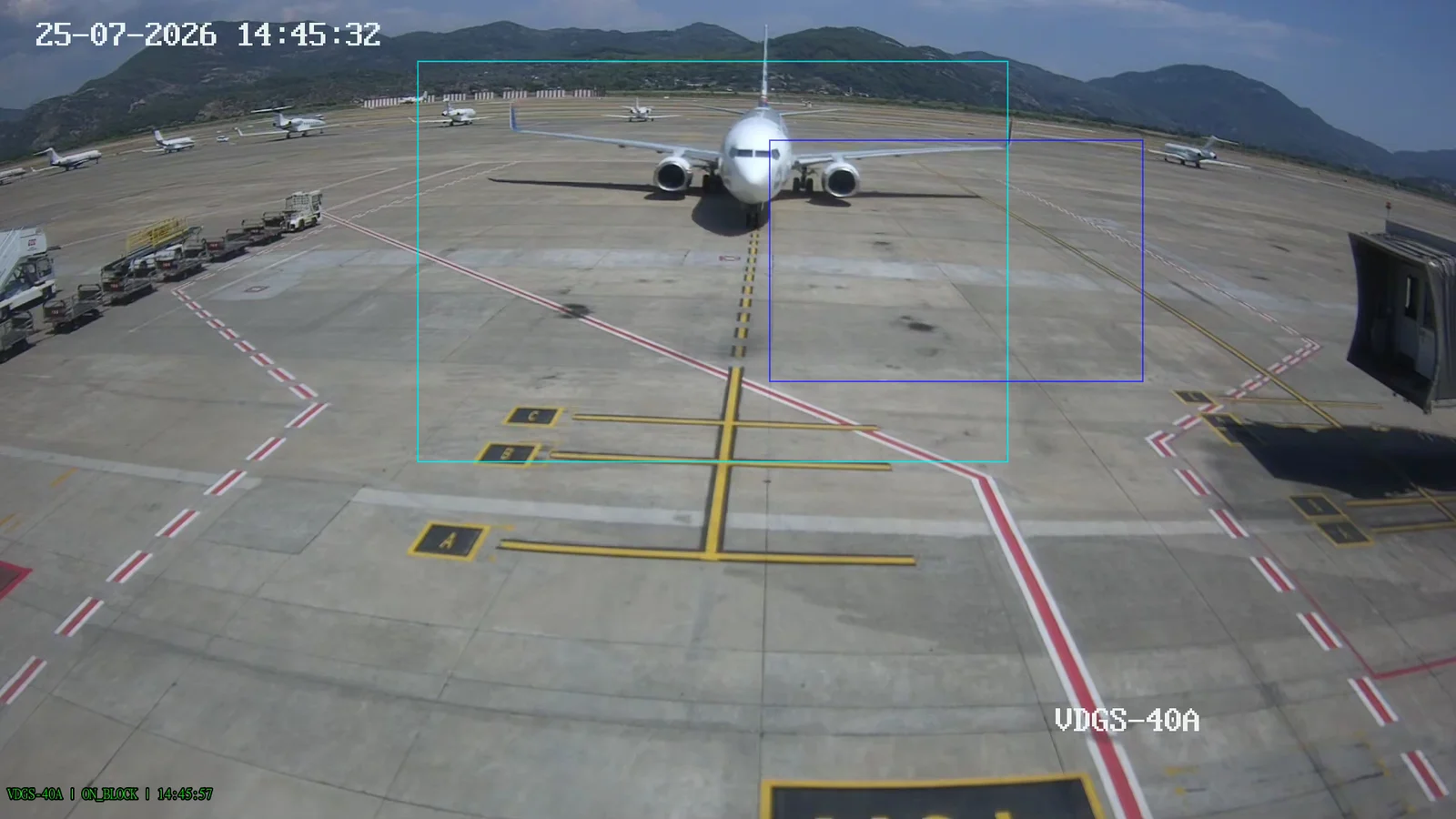
AI-POWERED APRON ANALYTICS
Apronex.
Aircraft turnaround monitoring. From your apron cameras.
Apronex turns camera feeds into aircraft and ground-service events. Follow contact and remote stand operations with automatic timestamps.
Operating 24/7 at Dalaman Airport (DLM)
Day operationsDLM / DALAMAN AIRPORT
Every hour. Every day. Dalaman.
Apronex runs 24/7 at Dalaman Airport. Day and night, through summer and winter, rain, fog, heat and cold.
INSIDE APRONEX
The whole apron. Every turnaround.
Monitor stands at a glance. Explore the services and event times of an individual flight.
- Flight and stand information
- AIBT, AOBT, on-block and off-block status
- Elapsed turnaround time
- Ground handling events
- Chronological event timeline
- Event source and validation status
TURNAROUND EVENTS
One turnaround. Parallel services.
Fuel, catering, baggage and other services do not follow a single sequence. Apronex records each service’s events separately and brings them together in the same flight and stand context.
The aircraft comes to a complete stop at its parking position.
The aircraft first moves from its parking position.
Services can overlap. Each row shows its own event relationships; there is no mandatory sequence between rows.
ChocksPlacementRemoval
Chock placement is recorded separately from AIBT. Chock removal is not AOBT either; AOBT is the aircraft’s first movement from its parking position.
PBBConnectionDisconnection
Bridge connection and disconnection are tracked separately. Bridge connection alone does not establish the start of boarding or deboarding.
Passenger stairsPositioningRemoval
Positioning at the aircraft door and removal are distinct events. Access equipment is selected according to the stand and aircraft operation.
GPUConnectionDisconnection
GPU cable connection and disconnection are tracked. A GPU seen on stand does not by itself establish that power is being supplied to the aircraft.
PCAConnectionDisconnection
PCA hose connection and disconnection are recorded separately, rather than combined with GPU service.
FuelFirst seenConnectionDisconnectionStand exit
Fuel vehicle or dispenser presence is separate from connection. A visually observed connection interval does not measure fuel flow or delivered volume.
Catering · FWDFirst seenDockingUndockingStand exit
The catering vehicle at the forward service door has separate arrival, docking, undocking and stand-exit events. Forward and aft records are independent; monitored doors are configured for aircraft type, service plan and camera coverage.
Catering · AFTFirst seenDockingUndockingStand exit
The catering vehicle at the aft service door has separate arrival, docking, undocking and stand-exit events. Forward and aft records are independent; monitored doors are configured for aircraft type, service plan and camera coverage.
Baggage / ULD · FWDFirst seenPositioningWithdrawalStand exit
The belt loader or high-loader serving the forward hold has separate first-seen, positioning, withdrawal and stand-exit events. Forward and aft hold records are independent. Equipment depends on the aircraft and loading configuration; positioning alone does not establish first bag off or last bag loaded.
Baggage / ULD · AFTFirst seenPositioningWithdrawalStand exit
The belt loader or high-loader serving the aft hold has separate first-seen, positioning, withdrawal and stand-exit events. Forward and aft hold records are independent. Equipment depends on the aircraft and loading configuration; positioning alone does not establish first bag off or last bag loaded.
Potable waterFirst seenConnectionDisconnectionStand exit
Vehicle presence and water-service connection are separate records. Connection duration is not interpreted as delivered water volume.
This view is not a flight record or a duration plan. Active doors, holds and equipment vary with aircraft type and service plan. Event scope is configured for the stand, camera coverage and local procedures. Expand a service for details.
EVENT SCOPE
From aircraft movements to ground services.
- On-block / Off-block
- Chock placement
- Aircraft type detection
- Fuel
- Catering (FWD / AFT)
- Baggage / ULD (FWD / AFT holds)
- Passenger stairs
- PBB
- GPU
- PCA
- Potable water
- Fire vehicle
Record when equipment is first seen, connects or takes position, and departs. Associate events with the correct flight and stand.
More than objects. Operational context.
Aircraft and equipment detections gain meaning through flight context, stand layout and event sequence.
- Each event is associated with the correct flight, stand and turnaround record.
- Intermittent detections are validated against the service connection–disconnection sequence and its timing.
- On-block is the aircraft’s complete stop; off-block is its first confirmed movement from the parking position.
Works with your existing airport systems
Apronex operates as an analytics layer that complements the airport's existing operational systems. It does not require replacement of the AODB.
Interfaces
- IATA AIDX
- REST API
- JSON
- XML
- Webhooks
- Project-specific interfaces
Supported systems
- AODB
- OCC operational screens
- Billing systems
- Equipment-planning systems
- Staff-planning systems
Events are validated, mapped and published according to the airport's integration and data-governance rules.
APRONEX AT YOUR AIRPORT
From existing infrastructure to the first live stand.
Camera coverage, stand rules and data flows are configured around your operation.
Works with compatible apron cameras
Generate operational data from existing apron cameras. Contact and remote stand deployments are configured to your airport layout.
Where required, camera repositioning, additional coverage or edge-processing infrastructure may be included in the project design. No sensors or tracking devices are installed on aircraft or GSE.
Built around real stand and turnaround rules
MARS stand configuration
Combined and split parking positions are modelled using parent and sub-stand relationships. A MARS position can operate as one wide-body stand or as two independently monitored narrow-body positions, according to the airport configuration.
Turnaround event sequencing
Camera-detected on-block establishes the active turnaround and stand-occupancy window. Service events are evaluated within that context, and off-block closes the parking occurrence.
Flight association
Camera and equipment events are associated with the correct flight, stand and parking record using AODB flight context and operational rules.
Privacy and data governance
Apronex can process camera streams on local infrastructure and produce operational events without facial recognition or biometric identification. Image retention periods, event-linked records and access permissions are configured according to the airport's data-governance requirements.
KVKK and GDPR requirements are addressed within the project scope, according to the agreed processing and retention model.
Where enabled, event-linked visual records can support service verification, billing review and dispute resolution.
Is equipment arrival the start of a service?
No. Seeing a vehicle at the stand is separate from detecting its connection or service position. Apronex tracks configured arrival, connection or positioning, disconnection and departure events separately. Fuel, catering and baggage services can overlap; they do not form one fixed sequence.
How are forward and aft services recorded?
Catering is separated by forward and aft door; baggage and ULD handling are separated by forward and aft hold. Each configured service has its own event lifecycle within the same flight and stand record. Coverage depends on the aircraft, camera view and agreed event scope.
What do AIBT and AOBT mean in Apronex?
AIBT (Actual In-Block Time) is the aircraft’s complete stop at its parking position. Chock placement is a separate event. AOBT (Actual Off-Block Time) is the aircraft’s first confirmed movement away from the parking position, not tug connection. Camera coverage and event rules are validated for the monitored stand.
How does a pilot work?
Define the scope
Review the stand, camera view and priority events together.
Validate in operation
Review the configured events under real turnaround conditions.
Connect your systems
Define the receiving systems and integration scope for validated records.
Start with one stand.
We assess camera coverage, configure the operational events that matter to your airport and validate Apronex under real turnaround conditions.
Pilot scope can include camera assessment, event selection, stand configuration, operational validation and integration review.